
Article: France’s Textile Heritage from Marie Antoinette’s Silks to the looms of Armentières”

France’s Textile Heritage from Marie Antoinette’s Silks to the looms of Armentières”
I have just returned from a business trip to France, where I was fortunate enough to revisit the magnificent Palace of Versailles—and even more fortunate to be there during the quieter, less touristy season.
I love Versailles. There is something quite extraordinary about seeing the spectacular Hall of Mirrors in all its glory, particularly when the sunshine is streaming through those enormous windows and illuminating the gilding, chandeliers and mirrors.
But, beautiful as it is, the Hall of Mirrors is not my favourite room at Versailles.
That honour belongs to Marie Antoinette’s bedchamber.
The exquisite textiles of Versailles
The Queen’s apartments underwent an extensive restoration before reopening to the public in 2023, and for me the bedchamber is particularly captivating for one reason: the textiles.
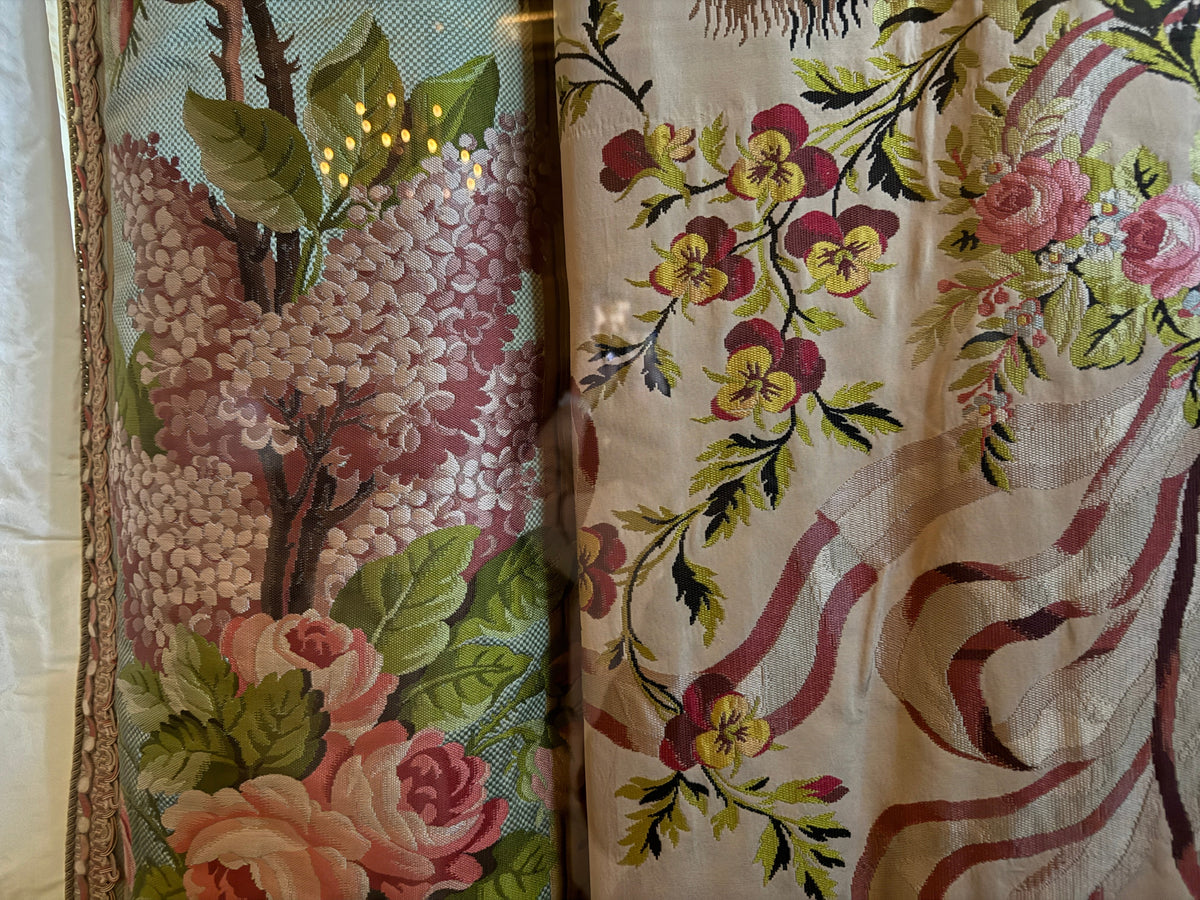
The magnificent window drapes are made from luxurious woven silk in the most delicious mixture of greens, pinks and purples.
One panel is filled with voluptuous pink roses, luscious green leaves and lilacs in full bloom. Another combines dainty pink dog roses, larger roses and violas, all intertwined with beautifully woven ribbons in shades of pale pink, white and deep plum red.
They really are exquisite.
Standing there admiring them, I was reminded that these fabrics are about much more than decoration. They represent centuries of French textile knowledge: weaving, colour, pattern, craftsmanship and an extraordinary attention to detail.
And, of course, I love textiles. It is why we sell them.
So perhaps it was inevitable that my journey would take me from the grandeur of Versailles to a very different part of France’s textile story.
From Paris to Hauts-de-France
From Paris I travelled northeast to Hauts-de-France, a region with a long and fascinating textile heritage and a history of technical expertise in weaving.
My destination was Lille, the historic capital of French Flanders.
Textiles have played an important role in this part of France since the Middle Ages, when the region became associated with flax, linen, woollen cloth and important cloth fairs. Lace manufacturing developed from the 16th century onwards, while the Industrial Revolution brought enormous growth in cotton and wool production, spinning and weaving.
Wars, globalisation and changing patterns of manufacturing transformed the industry dramatically during the 20th century. Today, much of the region’s textile expertise is concentrated on highly specialised and technical textiles.
But traditional weaving has not completely disappeared.
And that was precisely the reason for my visit.
A train to the ‘City of Canvas’
One of the companies keeping this heritage alive is Charvet Éditions, part of TRP Charvet, a textile manufacturer founded in 1866 in Armentières.
Armentières, historically associated with linen and canvas production, lies around 20 miles northwest of Lille and was once known as the “City of Canvas”.
I took the train from Lille—a journey of around 15 minutes—followed by a short walk to the factory.
The building immediately felt familiar.

A traditional red-brick industrial factory, it reminded me of the mills close to where I grew up in the industrial northwest of England. There is something wonderfully evocative about these buildings. They were designed for work and production rather than beauty, yet today they possess a character all of their own.
And inside, the Charvet factory was a hive of activity.
Inside Charvet Éditions
Charvet Éditions was established around 20 years ago, drawing on the company's longstanding technical textile expertise to create a wonderful collection of linen and canvas textiles for the kitchen, table and home.
Today, TRP Charvet is one of the remaining independent French manufacturers continuing this tradition of linen and canvas weaving.
The Armentières site operates around 40 looms, using both dobby and jacquard weaving techniques, and employs approximately 50 people.

What struck me during the visit was just how much happens within this relatively compact factory.
There is the yarn waiting to be woven, the looms themselves, equipment for checking the quality of the cloth and dedicated areas for cutting, washing and finishing. Alongside production sit the administration, warehouse and packing operations.
You really see the journey from yarn to finished textile taking place around you.


The company operates through a closely integrated French supply chain. Flax is grown in Normandy, with spinning and yarn dyeing taking place within the wider northern French textile region before the cloth is woven and finished at Armentières.
For someone who loves textiles, watching this process is fascinating.
What ‘Made in France’ really means
We often see the words Made in France, Made in Britain or Made in Italy on a label without necessarily thinking about everything those few words can represent.
Visiting Charvet made that meaning tangible.
Behind every finished tea towel, table runner, apron or piece of linen are the people operating the looms, checking the cloth, cutting and finishing it, packing the orders and maintaining skills that have been passed through generations of textile manufacturing.
When you buy a Charvet Éditions product, you are buying something genuinely woven and made in France, with a strong connection to French-grown flax and the historic textile industry of northern France.
More importantly, you are helping to sustain an industry that could so easily disappear.
From the silk drapes of Versailles to the looms of Armentières
At first glance, Marie Antoinette’s sumptuous silk drapes at Versailles and a working textile factory in Armentières might seem worlds apart.
For me, however, they are connected.
Both tell a story about France and textiles.
One represents the extraordinary decorative craftsmanship of the past: magnificent silks, elaborate flowers, glorious colours and fabrics created for one of the most opulent palaces in Europe.
The other represents a living textile tradition—looms running, yarn being woven and skilled people continuing to manufacture beautiful, practical cloth in France today.
Textile heritage only survives when those skills continue to be used.
That is one of the reasons we LOVE Charvet Éditions products. We love their quality, their colours, their designs and the wonderful tactile nature of linen. But we also love knowing where they come from and understanding something of the people, skills and history behind them.
We are delighted to continue supporting Charvet Éditions and this wonderful part of the French textile industry.
And we very much hope that, by continuing to choose and enjoy their products from us, you will help support it too.